
430000 BC INDONESIA TRINIL PSEUDODON SHELL ENGRAVING
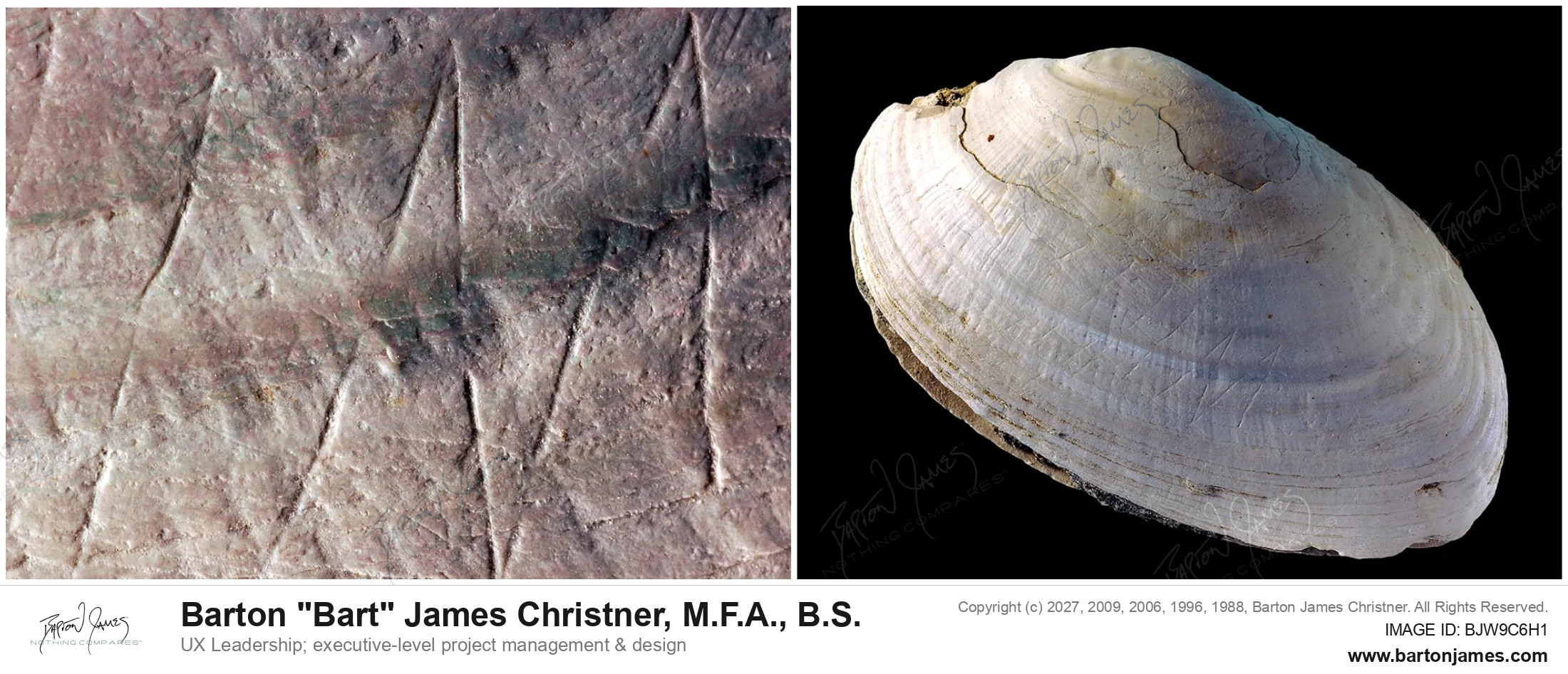
A freshwater mussel shell from the Solo river at Trinil, cut with a zigzag: an M, a set of parallel lines, and a mirrored N. It was collected by Eugene Dubois in the 1890s and sat unremarked in a museum drawer for a century. Analysis published in Nature in 2014 showed the grooves were engraved before the shell was buried and weathered, and dated them to between 540,000 and 430,000 years ago.
That places the marks in the hands of Homo erectus, not our own species. Until then, geometric engraving was assumed to begin with modern humans in Africa around 100,000 years ago. The Trinil shell moves the earliest deliberate pattern back by a factor of four and hands it to somebody else.
The card
- Date — 540,000 to 430,000 BP. This card uses the most recent end of the accepted range
- Material — Pseudodon shell DUB1006-fL
- Where — Trinil, Bengawan Solo, Ngawi, East Java. Approximate
- Correction — earlier notes here gave a range reaching 1,000,000 BP. That figure is not supported by the publication
- Find-site — Trinil, Bengawan Solo river, Ngawi. -7.40306, 111.44464 — approximate
Sources
- Joordens et al., "Homo erectus at Trinil on Java used shells for tool production and engraving", Nature 518, 2015
- PubMed record for the same paper
- Pseudodon shell DUB1006-fL
Images
- From the research archive. Photographer not yet identified; reverse-image attribution outstanding.
Works Cited
- Source, Title, Publisher, Year.